Sista Girl JD® | Legal Tools & Strategy for Creators & Pro Se Litigants

Father reviewing court papers related to service of process in a Texas SAPCR paternity case

How Service of Process Works in a Texas SAPCR

(And Why Your Case Can’t Move Forward Without It)

If you’ve filed paperwork in Texas to establish paternity, request DNA testing, or seek visitation — and now it feels like nothing is happening — you’re not alone. Many parents reach this point after filing what Texas courts call a SAPCR, and the silence that follows can be confusing and frustrating, especially when a child is involved.

A SAPCR stands for a Suit Affecting the Parent-Child Relationship. In plain terms, it’s the type of court case Texas uses for child-related matters, including paternity, custody, visitation, and court-ordered DNA testing. Filing a SAPCR starts the legal process — but it does not automatically give the court authority to act. That authority comes later, through service of process, which is where many cases quietly stall.

Understanding how service works — and why it matters — can save you weeks or even months of unnecessary delay.

What Types of Cases Use a Texas SAPCR?

In Texas, a SAPCR (Suit Affecting the Parent-Child Relationship) is used for a wide range of child-related court cases — not just paternity. This explanation applies to SAPCR cases involving:

  • Establishment of legal paternity

  • Court-ordered DNA testing

  • Initial custody or conservatorship determinations

  • Visitation or possession schedules

  • Child support orders

  • Temporary orders related to custody or visitation

  • Modification of existing SAPCR orders (when new service is required)

  • Cases involving newborns or recently acknowledged children

  • Cases where one parent has not yet been formally served

Regardless of the specific issue, most SAPCR cases share the same starting point: the court generally cannot take action until service of process is completed or properly waived.

Understanding how service works — and why it matters — can save you weeks or even months of unnecessary delay.

Father holding infant child, representing a family situation where a Texas SAPCR may be used
Illustration representing family Illustration representing common family-law situations where a Texas SAPCR is used to establish or modify parental rights.
Petition for child custody document, representing a court filing used in Texas SAPCR cases
Example of a court petition commonly filed in Texas SAPCR cases.

What “Service of Process” Means in Texas Family Court

In a Texas SAPCR, service of process is the formal way the other parent is legally notified that a case has been filed.

It’s not just a technical step — it’s the mechanism that gives the court power over the case.

In practical terms, service means:

  • The other parent has received official legal notice

  • The court can require a response

  • The judge now has authority to issue orders

Service of process is the step that formally brings the other parent into the case. Until that happens, the court cannot require the other parent to respond, attend hearings, or comply with requests for DNA testing or visitation.

This requirement exists to protect due process. Texas courts must be sure that each party has been properly notified before exercising authority over parental rights and responsibilities. Even when one parent is eager to move forward, the court cannot shortcut this step.

In practice, this means that filing the petition is only the first milestone. Service is what activates the court’s power to move the case into the next phase.

Until service is completed (or properly waived), the court is generally limited in what it can do.

This is true even when a petition has been filed correctly and even when the issues involve paternity or a newborn child.

Service is not optional, and it’s not automatic. It’s a required step before the case can move forward.

Get help preparing for a Texas family court case

If you’re navigating this process without an attorney, you can find additional guidance and resources on our Texas Family Legal Support for Self-Represented Filers page.

Legal notice being served as part of service of process in a Texas SAPCR case
Service of process is the formal legal notice that gives the court authority to act.
Judge issuing a court order after proper service of process in a Texas SAPCR case
A judge can issue orders in a Texas SAPCR only after proper service of process.

Additional Resource

For readers who want a general overview of the different ways initial court papers can be served in Texas family law cases, TexasLawHelp.org provides a nonprofit, court-supported guide here.

[How to Serve the Initial Court Papers (TexasLawHelp.org)

While that guide explains the mechanics of service, understanding how service fits into the overall SAPCR timeline — especially for paternity and DNA testing — is key to avoiding delays.

What Does Not Count as Service

Texting court papers does not count as service of process in a Texas SAPCR case
Informal communication, including texts or emails, does not qualify as service of process in a Texas SAPCR.
Emailing court papers does not count as service of process in a Texas SAPCR case
Emailing documents to the other parent does not qualify as service of process in a Texas SAPCR.

This is where many self-represented parents get stuck.

The following do not count as valid service in a Texas SAPCR:

  • Texting or emailing the petition

  • Mailing papers yourself

  • Telling the other parent about the case informally

  • Sending screenshots or social media messages

  • Assuming the clerk or court handles service

This is where many self-represented parents unintentionally lose weeks or months.

Many self-represented parents assume that because communication already exists between the parties, formal service is unnecessary. That assumption often leads to long delays.

Texas family courts require proof that service occurred in a legally recognized way. Informal communication — even when well-intentioned — does not create a court record and does not give the judge authority to act.

This is why cases frequently stall even when both parents are aware of the filing. Without proper service, the court must treat the case as incomplete, regardless of how reasonable the request may seem.

Even if the other parent clearly knows about the case, the court still needs proof that service happened in a legally recognized way.

🧾 Free Checklist: Is Service the Reason Your Case Isn’t Moving?

Many Texas SAPCR cases stall not because the paperwork is wrong — but because service of process was never properly completed or accepted by the court.

This free checklist helps you quickly identify whether service issues may be preventing the court from taking action in your case.


Proper Ways to Serve in Texas

Texas law recognizes specific methods for serving initial court papers in a SAPCR. These methods exist to ensure the other parent receives official legal notice in a way the court can verify.

Which option applies depends on cooperation, location, and how easily the other parent can be found.

Important note for new filings:
In most Texas family law cases — including a new SAPCR or original petition — the initial court papers generally must be personally served on the other parent. This means the papers are delivered by an authorized person, such as a constable, sheriff, or private process server, unless the other parent signs a valid waiver of service.

Personal service is typically required at the start of a case because the court must be certain the other parent received official legal notice before exercising authority over parental rights, DNA testing, or visitation.

Common, legally recognized methods include:

Constable or Sheriff

A constable or sheriff may serve the initial court papers in the county where the other parent lives or can be located. This is a common option when filing through the district clerk and is often used when the other parent’s address is known and service is expected to be straightforward.

Service by a law enforcement officer creates an official record the court can rely on if questions later arise about notice.

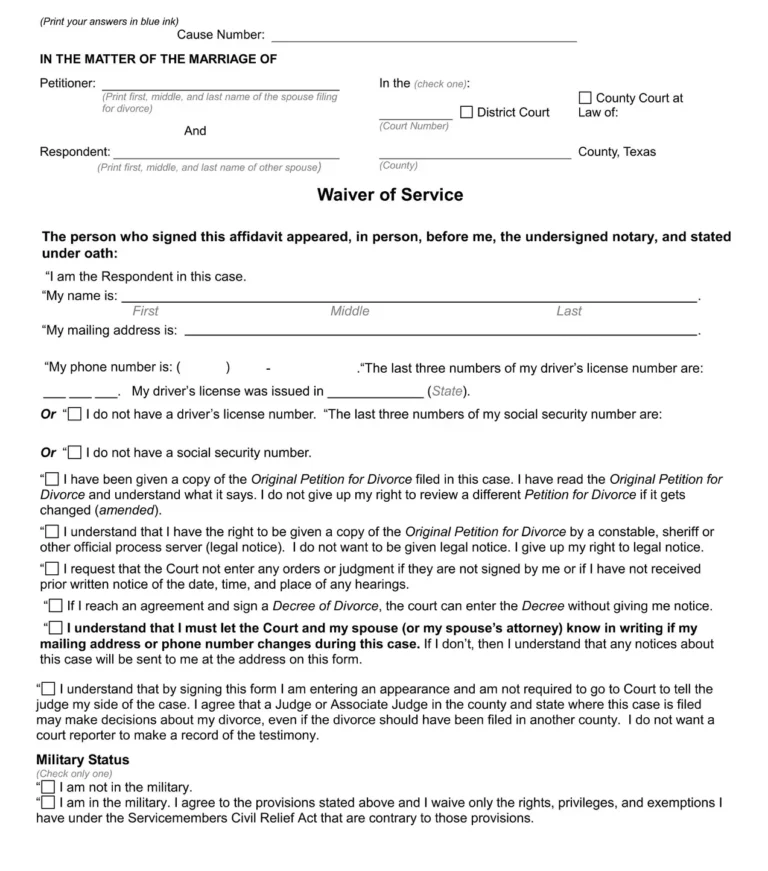
Waiver of Service

(If the Other Parent Is Cooperative)

In some cases, the other parent may agree to sign a waiver of service. This document confirms they are aware of the case and voluntarily waive formal service requirements.

A waiver does not mean the case is resolved or that rights are waived — it simply allows the court to move forward without formal delivery of papers. Waivers must meet specific legal requirements to be valid.

Why Choosing the Right Method Matters

Service that is done incorrectly — or not completed at all — can delay every other part of the case. Until service is completed or properly waived, the court generally cannot:

  • Order DNA testing

  • Set hearings

  • Issue temporary visitation orders

  • Require the other parent to respond

Choosing a valid method from the start helps avoid unnecessary resets and delays.


Official court papers prepared for service in a Texas family law case
Initial court papers that must be formally served on the other parent in a Texas SAPCR.
Texas sheriff’s deputy serving initial court papers as part of service of process in a SAPCR case
A sheriff’s deputy may serve initial court papers in a Texas SAPCR as part of proper service of process.
Texas waiver of service form used in a SAPCR when the other parent agrees to waive formal service
A waiver of service allows a Texas SAPCR case to move forward without formal delivery of court papers when the other parent cooperates.

A Note on Timing

Service is often the longest pause in a SAPCR case. That pause does not mean the case has failed — it usually means the court is waiting for proof that service occurred in a legally recognized way.

Understanding this upfront helps manage expectations and reduces frustration while the process plays out.

When service doesn’t happen easily — or when the other parent avoids it — additional steps may be required before the court can proceed.

Important Note for New filings

In most Texas family law cases — including a new SAPCR or original petition — the initial court papers generally must be personally served on the other parent. This means the papers are delivered by an authorized person, such as a constable, sheriff, or private process server, unless the other parent signs a valid waiver of service.

Personal service is typically required at the start of a case because the court must be certain the other parent received official legal notice before exercising authority over parental rights, DNA testing, or visitation.

Authorized individual attempting personal service of court papers at a residential door in Texas.
Personal service typically involves an authorized individual attempting to hand-deliver initial court papers to the other party.

Delays caused by improper or incomplete service often end up costing more than completing service correctly the first time.

Not sure which service method applies to your case?
A short, focused consult can help you confirm whether personal service is required and avoid delays caused by service mistakes.

This is an educational strategy call only. No attorney-client relationship is formed.

💲 What Does Service of Process Typically Cost in Texas?

Service of process fees vary by county, provider, and how easy the other party is to locate. While exact costs differ, most people can expect the following general ranges:

Constable or Sheriff Service

Typical range: $75–$100 per attempt

  • Often handled through the county constable’s office

  • May be required or preferred in some counties

  • Additional fees may apply for multiple attempts or rush service

Private Process Server

Typical range: $75–$150+ per attempt

  • Costs may increase for:
  • Multiple service attempts
  • Evening or weekend service
  • Hard-to-locate individuals
  • Some providers charge flat rates; others charge per attempt

Waiver of Service (If Cooperative)

Typical range: $0–$20

  • May include notary fees if required

  • Only available if the other party agrees and the waiver meets legal requirements

Planning Note: These are estimated ranges, not guaranteed prices. Always confirm current fees with the constable’s office or service provider in your county.

What Happens If the Other Parent Avoids Service

Avoided service is common — especially in paternity cases.

When service doesn’t happen right away, courts may allow:

  • Multiple service attempts
  • Use of alternate addresses or locations
  • Alternate service, but only with court permission

This is also why accurate address information is critical. Even small errors can lead to weeks or months of delay.

Importantly, until service is resolved, the court’s hands are often tied. 

Avoided service can delay any SAPCR case, whether it involves paternity, custody, visitation, or support.

Individual refusing to accept court papers during an attempted service of process.
Refusing to accept court papers does not prevent service and may require additional service attempts or court-approved alternatives.
Legal notice posted on a residential door after an attempted service of process in Texas.
When personal service is unsuccessful, courts may allow additional attempts or court-approved alternative service methods.

Why Service Delays DNA Testing, Custody, and Visitation

This is the point many parents don’t realize until they’re already frustrated. In SAPCR cases, service delays don’t just affect paternity or DNA testing — they can delay any court action involving custody, visitation, or support.

Here’s how the chain works:

  • No service = no court authority
  • No court authority = no DNA testing order
  • No court order = no legal determination of paternity, custody, or visitation
  • No legal paternity = no enforceable visitation rights

This is especially important in newborn cases. Courts may move carefully, but they still require service before taking action.

If service is delayed, everything else is delayed — even when everyone agrees DNA testing should happen.

If you’re unsure whether service has been completed correctly in your case, a short checklist can help you confirm what may be holding things up.
📌Download the Free Service Readiness Checklist

Common SAPCR Service Mistakes

Some of the most frequent issues seen in pro se paternity cases include:

  • Using the wrong or outdated address
  • Filing in the wrong county
  • Assuming the clerk arranges service automatically
  • Waiting too long to line up a process server
  • Believing informal notice is “good enough”

These mistakes are fixable — but they cost time, and time matters when a parent is trying to establish rights.

Family court form with pen highlighting SAPCR filing paperwork
Common SAPCR issues often stem from incomplete or incorrectly filed court documents.

When to Get Help

Person reviewing court paperwork at a table while deciding next steps in a legal process.
Reviewing paperwork and options can help determine when additional guidance may prevent delays in a court case.

Service issues don’t always require full representation, but they do benefit from strategy.

This is often the point where people seek help for:

  • Service readiness review
  • Address strategy and options
  • Drafting support tied to service issues
  • Using a starter packet to understand the full process

Sometimes a small correction early prevents months of delay late

Want the Big Picture?

Cover image of a Texas Paternity Starter Packet with checklists and guidance for SAPCR cases.
A beginner-friendly starter packet explaining the SAPCR process, service requirements, DNA testing, and what to expect after filing in Texas.

If you’re preparing to file a Texas SAPCR and want a clear overview of what happens before and after filing — including service, DNA testing, and temporary orders — you can download the Texas Paternity Starter Packet here:

[Texas Paternity Starter Packet – SAPCR, DNA Testing & What to Expect]

Inside the packet, you’ll also find references back to deeper explanations like this one, so everything connects.

That closed-loop approach helps you move forward informed — instead of guessing.

Final Note

Service of process may feel like a technical hurdle, but in Texas family court, it’s the key that unlocks the rest of the case. Understanding it upfront can save you time, stress, and unnecessary delays — especially when your goal is to be present in your child’s life.

Before You Leave — One Last Helpful Tool

If you’ve filed a Texas SAPCR and nothing seems to be happening, service of process is often the missing step.

This free, pro se–friendly checklist helps you:

  • Identify whether personal service or a waiver is required

  • Spot common service mistakes

  • Understand what must happen before the court can act

🎯Download the Free “Why Your Case Isn’t Moving Yet” Checklist

Picture of Sista Girl JD

Sista Girl JD

Written by Sista Girl JD, creator of practical legal education tools for Texas pro se litigants.
Sista Girl JD is a Texas-based legal educator creating plain-language resources for self-represented individuals navigating family law and other civil court processes. Her work focuses on clarity, preparation, and helping readers understand what courts require—without intimidation or unnecessary legal jargon.